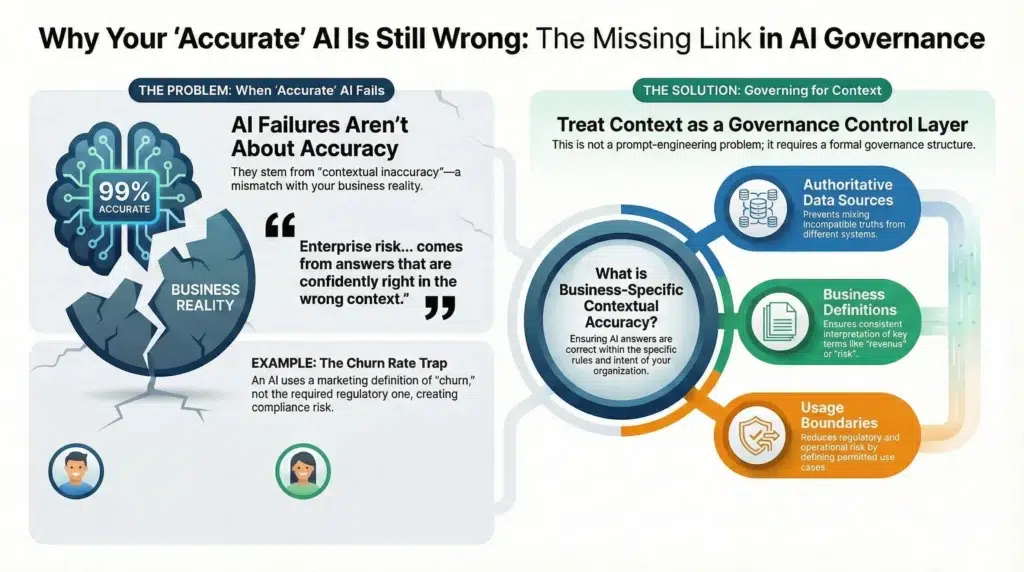
AI governance with business-specific contextual accuracy ensures that artificial intelligence systems operate responsibly while making decisions based on the unique goals, data, regulations, and workflows of a specific business. Instead of applying generic AI models, organizations customize governance policies and AI processes to match their industry requirements. This approach improves decision-making, reduces risks, strengthens compliance, and builds long-term trust with customers and stakeholders.
What Is AI Governance?
AI governance is a structured framework of policies, standards, and processes that guides how artificial intelligence is developed, deployed, monitored, and improved within an organization.
Its primary objective is to ensure AI systems remain:
- Accurate
- Transparent
- Secure
- Fair
- Compliant
- Reliable
Governance helps organizations balance innovation with accountability.
Understanding Business-Specific Contextual Accuracy
Contextual accuracy means an AI system understands the environment in which it operates.
Every business has different:
- Customers
- Products
- Regulations
- Internal workflows
- Risk tolerance
- Business goals
AI should consider these factors before generating recommendations or making automated decisions.
For example, an AI model used in healthcare requires different governance standards than one used in e-commerce or finance.
Why Context Matters in AI Governance
Generic AI solutions often produce inaccurate recommendations because they lack industry-specific knowledge.
Business-specific contextual accuracy helps organizations:
- Improve prediction quality
- Reduce operational mistakes
- Enhance customer satisfaction
- Strengthen regulatory compliance
- Increase employee confidence
Organizations that align AI with their operational environment generally achieve better long-term performance.
Key Principles of AI Governance
Successful AI governance is built on several core principles.
Transparency
Organizations should understand how AI systems reach decisions whenever possible.
Transparent AI increases trust among customers, employees, and regulators.
Accountability
Every AI system should have assigned owners responsible for monitoring performance and managing risks.
Fairness
AI should treat users consistently while minimizing unintended bias.
Regular testing helps identify unfair outcomes before they affect customers.
Privacy
Sensitive customer and business information should remain protected throughout the AI lifecycle.
Security
Organizations must defend AI systems against unauthorized access and cyber threats.
Building Business-Specific AI Governance
Creating an effective governance framework involves more than implementing technology.
Organizations should establish:
- AI policies
- Ethical guidelines
- Data quality standards
- Performance reviews
- Risk assessments
- Compliance procedures
- Employee training
These components support responsible AI adoption.
Comparison Table: Generic AI vs Business-Specific AI Governance
| Feature | Generic AI Governance | Business-Specific AI Governance |
|---|---|---|
| Context Awareness | Limited | High |
| Decision Accuracy | Moderate | High |
| Industry Compliance | Basic | Tailored |
| Customer Relevance | General | Personalized |
| Risk Management | Standard | Industry-focused |
| Long-Term Value | Moderate | Strong |
The comparison highlights why customized governance often delivers better business outcomes.
Data Quality and Contextual Accuracy
Accurate AI begins with reliable data.
Organizations should maintain:
- Clean datasets
- Updated records
- Secure storage
- Consistent formatting
- Data validation processes
Poor-quality data frequently leads to incorrect AI recommendations regardless of model sophistication.
Industry-Specific Applications
Different industries require unique governance strategies.
Healthcare
Priorities include:
- Patient privacy
- Clinical accuracy
- Regulatory compliance
- Secure medical records
Financial Services
Key concerns include:
- Fraud detection
- Risk assessment
- Transaction security
- Regulatory reporting
Retail
Businesses focus on:
- Customer personalization
- Inventory optimization
- Product recommendations
- Demand forecasting
Manufacturing
Manufacturers use AI for:
- Predictive maintenance
- Quality control
- Production planning
- Supply chain optimization
Each industry benefits from customized governance aligned with operational needs.
Risk Management
Every AI implementation introduces potential risks.
Common risks include:
- Algorithmic bias
- Poor data quality
- Cybersecurity threats
- Regulatory violations
- Inaccurate predictions
- Reputational damage
Regular audits help organizations identify and reduce these risks before they become major issues.
Employee Training
Technology alone cannot ensure responsible AI.
Employees should understand:
- AI ethics
- Data privacy
- Responsible AI usage
- Governance policies
- Reporting procedures
Continuous education strengthens organizational accountability.
Monitoring AI Performance
Businesses should continuously evaluate AI effectiveness.
Useful performance indicators include:
- Prediction accuracy
- Customer satisfaction
- Operational efficiency
- Compliance rate
- Security incidents
- Return on investment
Regular monitoring supports continuous improvement.
Case Study: Improving Contextual Accuracy
A regional insurance company introduced AI to automate policy recommendations. Initially, the system relied on generalized datasets, resulting in inconsistent recommendations for customers with specialized coverage needs.
The company enhanced governance by incorporating business-specific underwriting rules, industry regulations, and historical customer data into the AI model. Accuracy improved significantly, customer complaints decreased, and policy approval times became faster.
This example demonstrates how contextual accuracy directly improves business performance.
Personal Experience and Expert Insights
From reviewing organizations implementing AI, one observation remains consistent: business context is often more valuable than model complexity.
We’ve seen organizations achieve stronger outcomes by investing in data quality, governance policies, and employee training rather than relying solely on advanced AI models.
Experts also emphasize involving legal, technical, operational, and executive teams throughout the AI lifecycle.
Future Trends in AI Governance
AI governance continues evolving rapidly.
Important developments include:
- Explainable AI
- Automated compliance monitoring
- Industry-specific governance frameworks
- AI ethics committees
- Predictive risk analysis
- Continuous model auditing
- Advanced cybersecurity integration
Organizations that adopt these practices early gain a competitive advantage.
Best Practices
Businesses should focus on:
- Aligning AI with business goals
- Maintaining high-quality data
- Reviewing AI performance regularly
- Strengthening governance policies
- Protecting customer privacy
- Training employees continuously
- Updating governance frameworks as regulations evolve
These practices support sustainable AI adoption.
Read More: techupline
Pro-Tip
The most successful AI systems are not necessarily the most advanced—they are the ones that understand your business context. Combining strong governance, quality data, and industry-specific knowledge leads to better decisions, improved compliance, and greater customer trust.
Frequently Asked Questions
What is business-specific contextual accuracy in AI?
It refers to customizing AI systems so they understand the unique goals, data, regulations, and workflows of a specific business, leading to more accurate and relevant decisions.
Why is AI governance important?
AI governance ensures artificial intelligence is ethical, secure, transparent, compliant, and aligned with business objectives.
How does contextual accuracy improve AI performance?
Contextual accuracy allows AI to make decisions based on industry-specific information, reducing errors and improving operational efficiency.
What industries benefit most from AI governance?
Healthcare, finance, retail, manufacturing, logistics, and education all benefit from governance frameworks tailored to their specific requirements.
How can businesses improve AI governance?
Businesses should establish clear governance policies, maintain quality data, monitor AI performance regularly, train employees, and review compliance continuously.

![The Ultimate Guide to Choosing a [techypaper] Supplier in 2026](https://techupline.com/wp-content/uploads/2026/05/The-Ultimate-Guide-to-Choosing-a-techypaper-Supplier-in-2026-330x220.png)